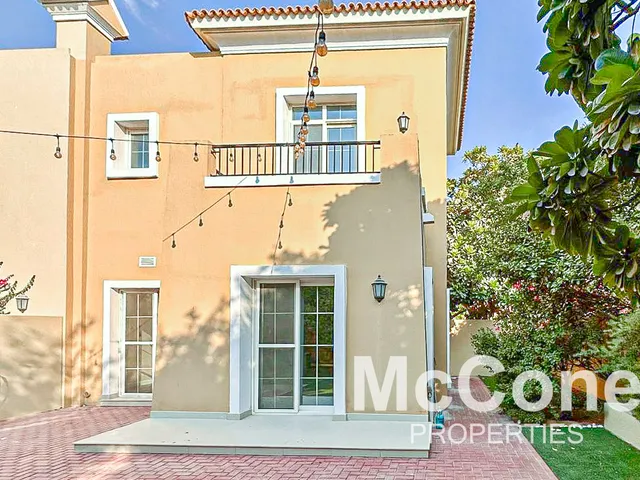
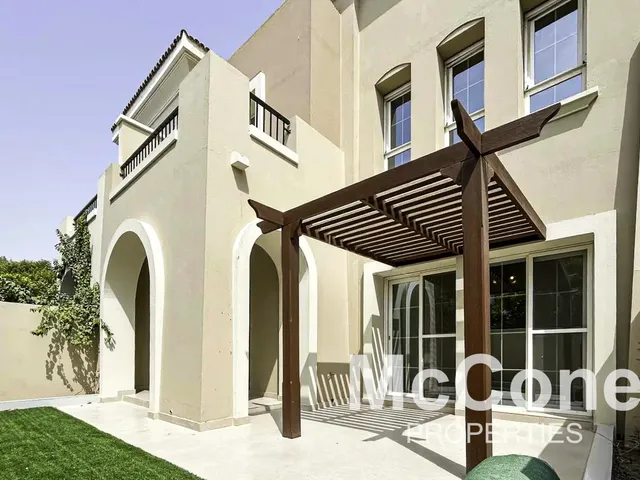
AED 269,999/ year
3 bedroom townhouse in Al Reem 3
4 bath · 3,160 sqft · Fully Upgraded · Vacant · Maids + Study
Dubai area guides › Community
Arabian Ranches is the community that taught Dubai's families to live in the desert. Every figure is McCone Properties’ own count from the Dubai Land Department’s registers: sales through October 2026.
What Arabian Ranches actually sells for — every building, ranked by recorded price →
Schools near Arabian Ranches — KHDA ratings, curriculum and fees →

At a glance
The guide
Arabian Ranches is the community that taught Dubai's families to live in the desert. Emaar built it on the Al Qudra Road at the start of the freehold era, a set of villa neighbourhoods around a golf course and a polo club, with a school, a souk and mature trees that have now had two decades to grow, and it has been the city's standard for an established family suburb ever since. Its two younger siblings across the road, Arabian Ranches 2 and Arabian Ranches 3, have their own guides; this is the original.
The community sits at the junction of Al Qudra Road and Sheikh Mohammed bin Zayed Road, with Motor City and Dubai Studio City across the highway and its siblings, Mudon and the desert on the Al Qudra side. Inside the gate it is laid out in named villa neighbourhoods on quiet loops, each with its own pools and parks, around the golf course and the polo and equestrian club. The souk at the centre holds the community's shops and cafes, the school sits inside the gate, and the trees, planted at the start, now shade the streets.
It was the first of the desert villa communities, built when the road to it was empty on both sides, and the communities that followed on that road, its own siblings, Mudon, Town Square and the Damac developments, were drawn on its pattern: a gate, a golf course or a park, named neighbourhoods, a school, a souk. It remains the one with the oldest trees.
It is the most settled of the desert suburbs, and it feels like it.
Villas, in the developer's original layouts, from compact family houses in the earlier neighbourhoods to large golf-facing and polo-facing homes, and townhouses in a few of the neighbourhoods. Many have been extended or rebuilt by their owners over the years, so the streets are less uniform than their plans, and the register records the gap between an original and an upgraded house. There are no apartments.
The neighbourhoods carry names and buyers learn them: which are nearest the school and the souk, which face the course, which are the largest plots, which were built first.
By car. Sheikh Mohammed bin Zayed Road and Al Qudra Road are at the gate, the Marina and the Media City offices are a manageable commute, Downtown is longer and the airport longer still. There is no Metro; the community's buses reach the nearest station. Inside the gate the loops are quiet, children cycle to school and the Al Qudra cycle track begins nearby.
The souk carries the supermarket, the cafes, the restaurants and the daily services, and the golf club and the polo club carry the community's social life and its weekends. The school inside the gate is one of the city's established ones, with a second in the sibling community across the road and nurseries in the neighbourhoods. The larger malls are a drive. For a family the community is nearly self-contained, which is what its residents pay for.
The polo and equestrian club is the community's distinction, with its fields, its stables and its winter season, and the golf club beside it has one of the city's better courses. Both are open to the community and to members from outside it, and their restaurants are where the community eats out.
Families who want an established villa community with mature trees, a school inside the gate and neighbours who have been there for years. Buyers who want a house to live in rather than an investment to let, which is most owners here. Golfers and riders, for whom the clubs are a reason on their own.
It suits people less well who want new-build finish, an apartment, a short commute to the centre or the airport, or the lowest price for a house in the desert suburbs, which the younger communities further out now offer.
The community's houses have a deep record on the register, neighbourhood by neighbourhood, and the tables on this page show what each layout has actually fetched. The gap to read is between original houses and rebuilt ones, and between plots facing the course, the polo fields or a park and those on internal streets; the register files a villa sold with its plot against the plot, and this page reads those sales correctly. There is little off-plan here, the community having been built long ago.
The letting market exists but is thinner than in the younger communities; for those homes that are let, the official index caps a renewal while a new lease follows the market.
Arabian Ranches 2 sits across the road, built by the same developer a decade later with newer houses, its own school and its own gate; Arabian Ranches 3 sits further along the road, newer again, with the developer's latest layouts and a park at its centre. They are separate communities with separate markets and separate guides, and the register keeps them apart. A price for one is not a price for the others.
The original neighbourhoods around the souk and the school are the community's heart; the golf-facing and polo-facing neighbourhoods are its top end; the townhouse neighbourhoods its entry point. The table below shows where the community's sales are actually happening, and every neighbourhood has its own page with every recorded price.
What it costs to buy
Completed resales over the last three years, by layout — the registered price and the registered floor area. Off-plan launches are counted separately and never folded in.
| Layout | Typical size | Median price | Mean price | Per sq ft | Sales |
|---|---|---|---|---|---|
| 3 B/R | 2,762 sqft | 4,462,500 | 4,720,833 | 1,498 | 6 |
Over the last 12 months, 21 completed homes changed hands in Arabian Ranches at a median of AED 14,000,000 — AED 1,578 a square foot, up 15% on the year before.
Every Arabian Ranches building ranked by recorded price, and every sale as registered →
The villa projects
Median price per square foot of completed resales over the last two years, dearest first — too few sales in the last ninety days to rank by activity.
| # | Project | Sales, 24 months | Median per sq ft |
|---|---|---|---|
| 1 | Alma 2 | 5 | 1,872 |
| 2 | La Avenida 2 | 7 | 1,651 |
| 3 | Aseel | 17 | 1,514 |
| 4 | Alvorada 3 | 9 | 1,375 |
| 5 | Polo Homes | 13 | 1,197 |
The 5 with five or more completed resales in two years. 7 villa projects in Arabian Ranches carry a recorded history, and each has its own page. The full table →
Every building
Every project with a page of its own, alphabetically — its registered prices, sizes and the year it was handed over wherever the Dubai Land Department has a sale on record, and our homes in it where it has none yet.
Alma 1 · Alma 2 · Alvorada 3 · Aseel · La Avenida 1 · La Avenida 2 · Polo Homes
On the market · Arabian Ranches

Who to ask
Associate Director
Elle holds 1 of the 2 homes McCone is marketing in Arabian Ranches today, and hears about the rest before they reach a portal. Ask for Elle at the desk.
Questions people ask
Arabian Ranches sits at the junction of Al Qudra Road and Sheikh Mohammed bin Zayed Road, with Motor City and Dubai Studio City across the highway and its siblings, Mudon and the desert on the Al Qudra side.
By McCone Properties' count of the Dubai Land Department register, 21 completed homes changed hands in Arabian Ranches over the last 12 months at a median of AED 14,000,000 — AED 1,578 a square foot, up 15% on the year before. Every figure is a registered transfer, not an asking price.
On McCone Properties' reading of the Land Department's sales register, completed three-bedroom homes in Arabian Ranches sold for a median AED 4,462,500 over the last three years — typically 2,762 sq ft, or AED 1,498 a square foot — across 6 recorded sales.
McCone Properties counts 7 villa projects in Arabian Ranches with a sale history on the Land Department register. Each has its own page with every registered price, and 5 of them have enough recent resales to be ranked by price per square foot.
Of the 30 sales the Land Department registered in Arabian Ranches in 2025, McCone Properties counts 0 off-plan purchases from a developer and 30 resales of finished homes — an established community trading hands. The register has 569 sales for Arabian Ranches since 2008.
New to renting or buying here? Ejari, the RERA rental index and the cost of buying, explained.